Derek Moscato, PhD
-
The past year has brought some new and exciting adventures both inside the classroom and beyond campus. Last winter, motivated by classroom discussion and the encouragement of our esteemed (and recently retired) journalism professor and historian John Harris, I embarked on new research about the history of lacrosse in the Pacific Northwest. The Bellingham Lacrosse Club, which launched in 1904, enjoyed four mostly-glorious years of action playing some of the best teams in the region before vanishing suddenly. Drawing from some colorful accounts in the Bellingham Herald (thanks to Whatcom Museum and archivist Jeff Jewell) and other regional press I learned that lacrosse captivated the Bellingham community, and even rivalled baseball for prominence, before fading away in the early 1900s. It was fun bringing this research to both the Seattle meeting of the Association for Canadian Studies in the United States this past fall, as well as to the pages of the recent issue of Whatcom Historical Quarterly. If you’re interested, the article is called “Canada’s Game in the Northwest Borderlands; The Bellingham Lacrosse Club’s Sport Diplomacy, 1904-1908.”
That focus on borderlands also brought me down to Seattle in March for the annual meeting of the Association for Borderlands Studies. While there, I was able to join my collaborators from WWU’s Border Policy Research Institute and the University of Texas at El Paso to discuss media coverage of the 2024 U.S. election in Canada, Mexico, and the U.S. Our recent visual journalism graduate Eli Voorhies also presented innovative borderlands media research developed in senior media research seminar, and he was introduced at ABS by none other than Don Alper, the founder of the Border Policy Research Institute and a longtime champion of Canadian studies at Western.
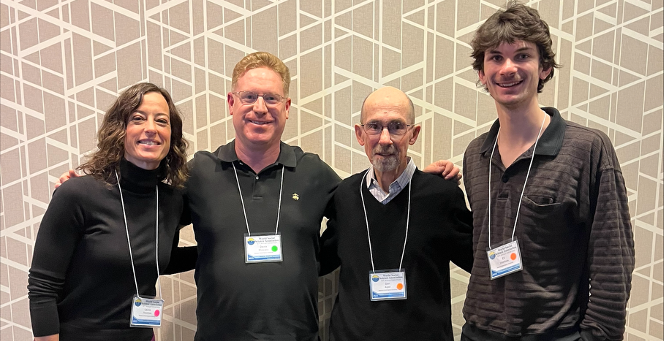
A faculty/student delegation from Western Washington University attended the Association for Borderlands Studies conference in March 2025. From left, Laurie Trautman (Border Policy Research Institute Director), Derek Moscato, WWU Professor Emeritus Don Alper, and WWU Journalism graduate Eli Voorhies. Speaking of our neighbors to the north, I was thrilled to teach the Canadian-American Media Systems class to Western students in the spring. As a collaboration between the Department of Journalism and the Center for Canadian-American Studies, the class examines cross-border journalism and broadcasting, media policy, and cultural flows including music and film. Our spring class concluded with a visit to the British Columbia headquarters of the Canadian Broadcasting Corporation (CBC), where students had the opportunity to contemplate news production up north, French-language broadcasting, and even the state of U.S.-Canada relations. Afterwards, we embarked on my first (but hopefully not last) Hollywood North walking tour through the streets of downtown Vancouver, where I did my best impression of a real tour guide. I’m hoping to replicate this one in the years ahead.
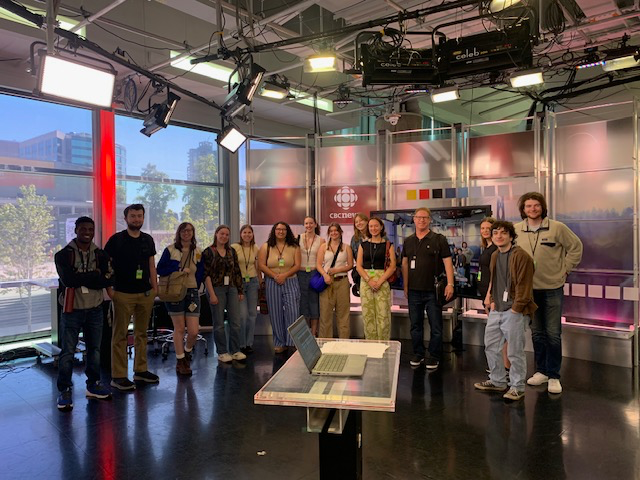
Students from the Canadian-American Media Systems class visited the B.C. headquarters of the Canadian Broadcasting Corporation during spring quarter 2025. To follow-up the CBC visit, Moscato led a Hollywood North walking tour through the streets of downtown Vancouver. Quality time was spent more recently in another archive, this time as part of the WWU James W. Scott Regional Research Fellowship at the Center for Pacific Northwest Studies. I’ve been learning about the legacy of the Whatcom County Nuclear Arms Freeze. During the early 1980s, public fears over nuclear weaponry reached new heights internationally and in Bellingham. Cold War politics, pitting the United States against the Soviet Union, raised unprecedented fears about the devastating consequences of nuclear conflict between the two countries. The Whatcom Nuclear Arms Freeze, itself the local dimension of a national movement that was spreading across the United States and Canada, proved to be a public advocacy force, as it integrated strategic communication, media relations, and organizing savvy to mobilize the local public against the build-up of nuclear arms. The way that folks from across Whatcom County, including Western’s campus, came together to support each other and the planet leaves me both hopeful for this region and also energized for the possibilities of environmental media in the years ahead.