The last year has been filled with a lot of global experiences for me.
After my Fulbright scholar grant in the West Bank was cut short in 2023, I was able to be reassigned to Jordan. It was my second time as a Fulbrighter in Jordan. I spent the fall of 2024 working at Yarmouk University in Irbid.
I was hosted by my colleague Dr. Naheda Makhadmeh, who is a friend and frequent research collaborator since our days as grad students at Michigan State. She served as vice dean of the Faculty of Mass Communication and was instrumental in helping me make connections at Yarmouk. I made great contacts with the Refugee, Displaced Person, and Forced Migration Studies Center, where I helped start an English language conversation club.
While at Yarmouk, I worked on research and accreditation projects and gave guest lectures in undergraduate and graduate classes. I also took part in UNESCO’s Global Media and Information Literacy Week in Amman and the annual meeting of the Arab-US Association of Communication Educators in Cairo.
The experience wasn’t only intellectually stimulating — it was also culturally rich. I took classes in the regional dialect of Arabic. I studied traditional Arabic musical instruments (the oud and the mijwiz). I also organized a workshop for my Fulbright colleagues in dabke, a traditional dance in the region.
I recently learned that I was named to the Fulbright specialist roster for the next three years. This means I will be able to work on short-term projects with international institutions. I’m excited to learn where life will take me next.
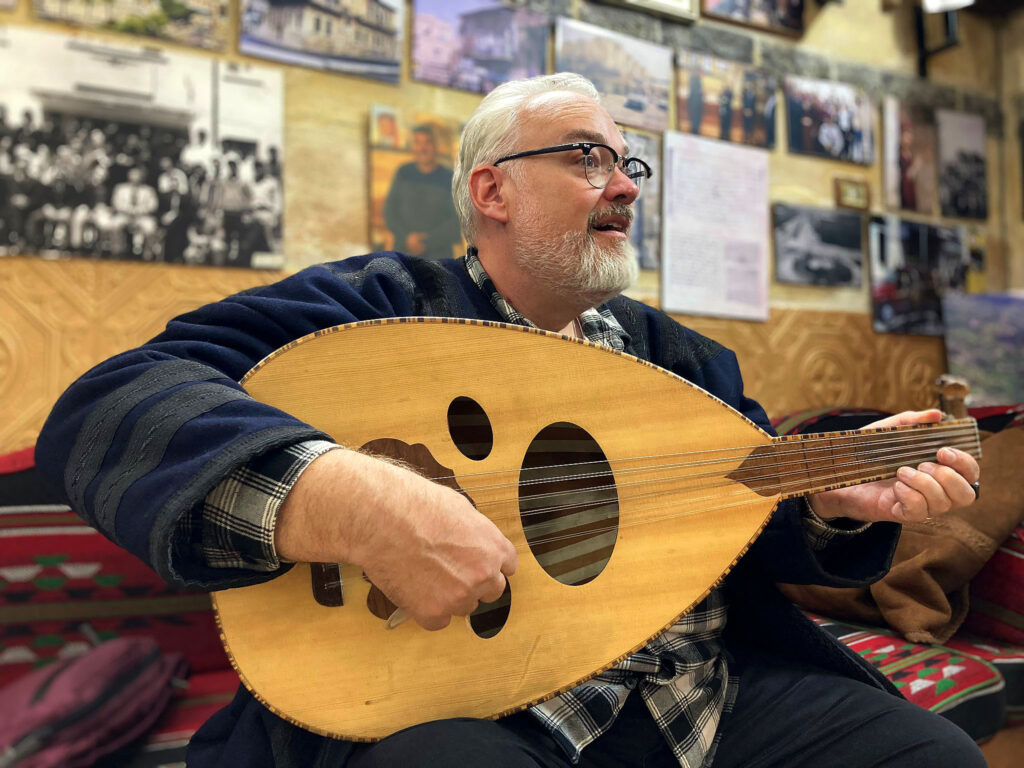
Brian J. Bowe plays the oud, a traditional Arabic instrument, at a community hub in Irbid, Jordan, at Yarmouk University in fall 2024. // Photo courtesy of Brian J. Bowe
It would be a serious understatement for me to say that the last year has been an eventful one for me.
Last summer, I worked with Western political science professor Bidisha Biswas on a U.S. State Department-funded project to provide media literacy training to young Palestinian content creators. We led workshops in Jerusalem and Ramallah, and we worked with Palestinian filmmaker Dina Amin on a short film titled “Creating Change.” The film took the silver award in AEJMC’s inaugural Festival of Visual & Interactive Media.
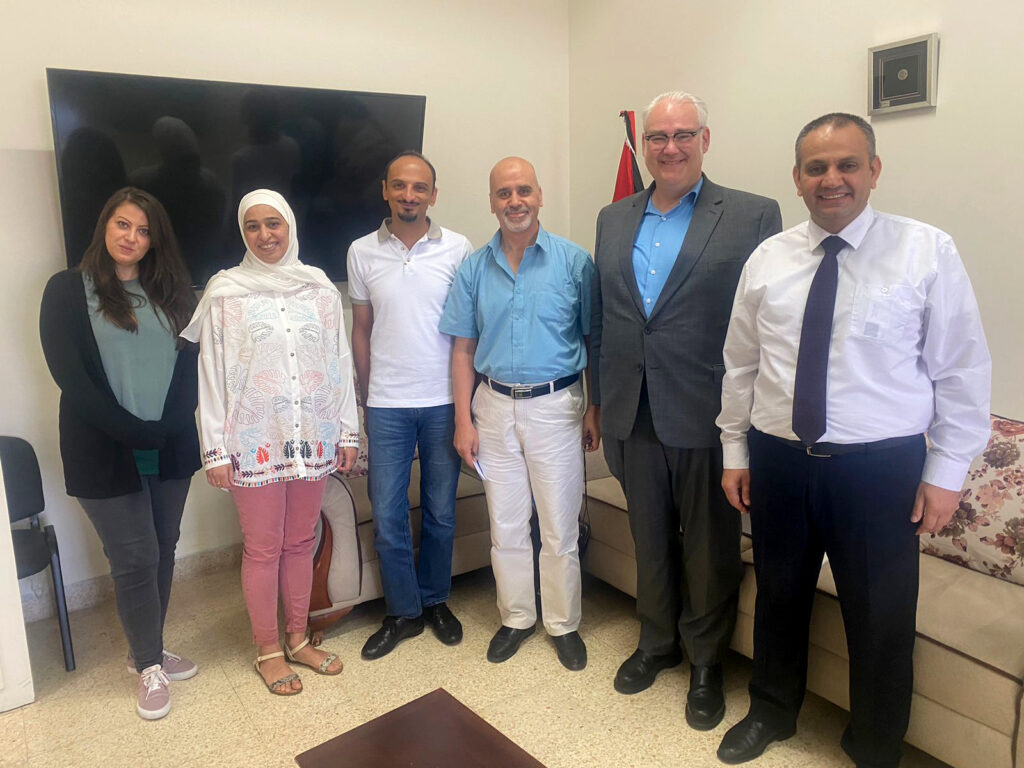
Bowe, second from right, meets with An-Najah colleagues Alia Gilbrecht, Yasmine Shahrour, Faisal Saleh, Farid Abudheir and Ra’fat Al-Jallad.
I returned to the West Bank in September to serve as a Fulbright Scholar at An-Najah National University in Nablus. My work plan involved research collaborations and curriculum design. My time in Nablus was shaping up to be very productive. However, my work was sadly interrupted by the increase in hostilities following the Oct. 7 attacks. I was eventually evacuated to Jordan, where I stayed for a few weeks before returning home. I’m continuing to work remotely with some of my colleagues from An-Najah.
This has been a very productive era for me in terms of research. I have a series of projects going with teams in Palestine, Jordan and Egypt, and I’m mapping out additional projects in Cameroon and Mongolia. I’ve published three journal articles so far this year, and I’m presenting two papers at the Association for Education in Journalism and Mass Communication conference in Philadelphia this August.
The last year has been hectic outside of work, too. I spent the better part of 2023 helping my family operate an 84-year-old art deco movie theater in Michigan after the theater’s owner — my uncle Joe Yuchasz — passed away in January. The Elk Rapids Cinema has always played a big role in my life, and it was an honor to help continue my uncle’s legacy. Running a movie theater is a great deal of fun, but it is also challenging. At the end of the year, the family sold the cinema to a nonprofit organization, and they’re doing a fantastic job.
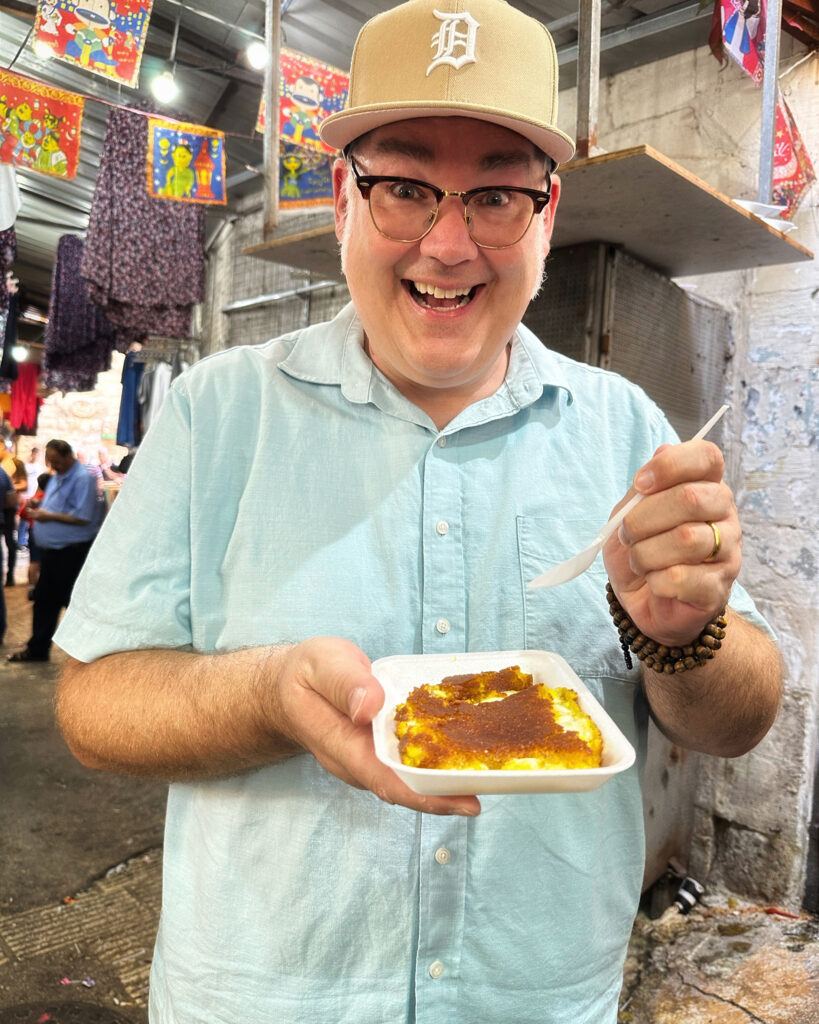
Brian J. Bowe enjoys a knafeh in September 2023, which is a dessert that is a specialty of Nablus.
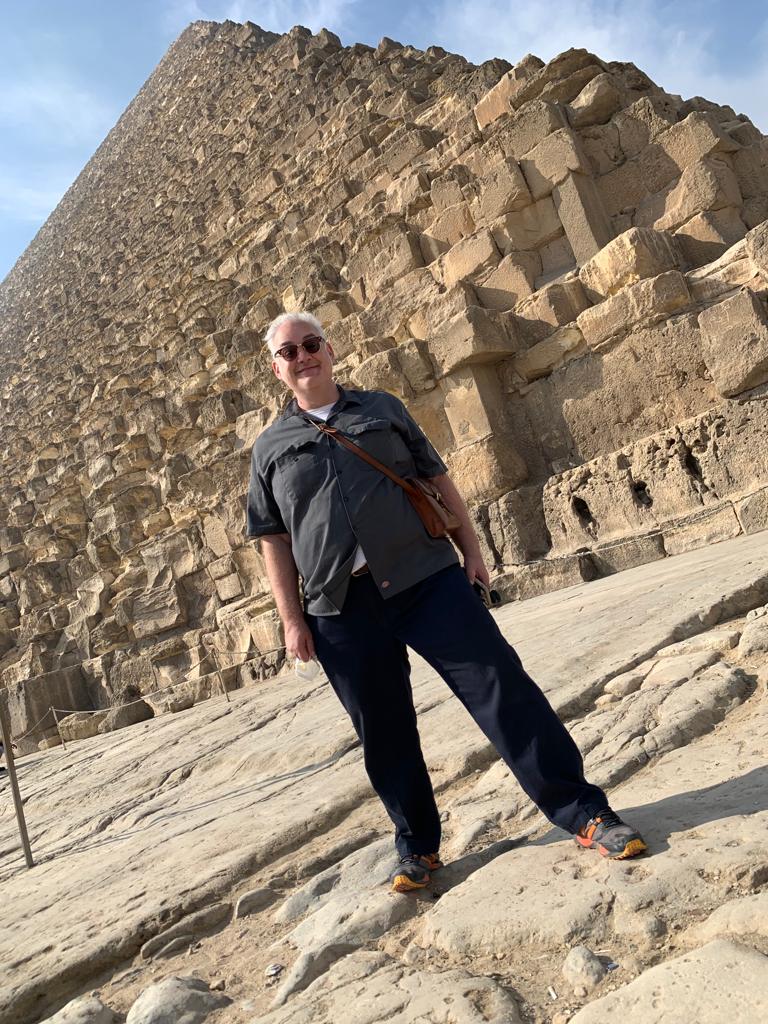
I spent most of 2021 on leave from Western to spend time teaching in the American University in Cairo’s Journalism and Mass Communication Department. In Arabic, Egyptians refer to Cairo as the “umm al dunya” — the mother of the world. It can be overwhelming to contemplate the sweep of history when strolling on the banks of the Nile or taking an Uber to the pyramids. But Cairo is not just some antiquarian’s dream. It’s a thrilling city with a beautiful beating heart. I enjoyed working with the creative and energetic students and faculty colleagues at AUC, and I learned so much.
Photo by Kim Fox
Spending time in Egypt was a continuation of my engagement with the Middle East and North Africa region. In recent years, I’ve also done work in Jordan, Tunisia and Morocco. I was recently awarded a fellowship by the Palestinian American Research Center, and I will be attending their faculty development seminar in the West Bank in June.
I had some good successes with research in 2021. I published an article on Islamophobia on Twitter; another on the communication strategies of a Muslim American advocacy group; and a third about Tunisian journalism students. I was grateful to get to work with my journalism department colleagues Derek Moscato, Carolyn Nielsen and Joe Gosen on these projects.
Professors Nielsen and Gosen and I continue to work on our U.S. State Department-funded project with the Tunisian journalism school IPSI. The pandemic has upended our work several times, but the current plans are to welcome a Tunisian delegation to Detroit for the Association for Education in Journalism and Mass Communication conference in August. If you’ve met me, you know how much I love Detroit, so it will be nice to show people around.
On a personal note, my father, Jack Bowe, passed away in February 2021. My dad was a television journalist with a five-decade career as a news director that included an Emmy and induction into the Nevada Broadcasting Hall of Fame. As a kid, I always loved it when he would bring me to the newsroom. Eventually, he’d let me write little things, and those long hours are what sparked my lifelong love of journalism. My dad specialized in long-form video features — a genre that has all but disappeared from local TV news. One of my favorites is this 1986 short film he did for WYTV in Youngstown, Ohio, about the closing of the Idora Park Ballroom. This piece marked the end of an era — as did his passing.
If 2019 was the year I traveled the most in my life, 2020 was the year I traveled the least.
Photo by Joe Gosen
Throughout 2019, I spent time teaching, researching and talking about journalism in Jordan, France and Tunisia. Like a lot of folks, I had big plans for 2020 that were dashed by the pandemic. In addition to my teaching, I published three journal articles related to journalism education, including one about ACEJMC accreditation (which our department is now pursuing) and two about capstone classes. I also managed to do a little music journalism for Detroit’s Metro Times weekly, writing about the death of acclaimed soul singer Sweet Pea Atkinson and Michigan Sen. Gary Peters plans for a bailout for the pandemic-ravaged live music business.
As 2021 began, I boarded a plane for the first time in a year. I’m currently in leave from Western and am based in Egypt, where I am teaching in the Journalism and Mass Communication Department of The American University in Cairo.
In 2019, I spent more time outside of Bellingham than I did in it. Throughout my travels in Jordan, France and Tunisia, I had many transformative experiences that will influence my teaching and research for years to come.
I spent the first half of the year in Amman, teaching in the American Studies graduate program at the University of Jordan as a Fulbright scholar. In addition to my teaching duties, I gave a public talk on my research at the University of Jordan, and I guest lectured in three classes in the journalism program at Yarmouk University in Irbid. At Yarmouk, I was able to reconnect with a friend and colleague from my doctoral studies at Michigan State University, Naheda Makhadmeh, who is now the chair of the journalism department there. I tried to immerse myself in Jordanian culture in as many ways as I could. I studied the Jordanian dialect of Arabic, I learned how to play the oud, and took a class on the regional dabke folk dance. I also explored Amman’s music scene and wrote an article about the group 47Soul for the Detroit Metro Times.
Only a few weeks after I returned from Jordan, I boarded another plane — this time to the World Journalism Education Congress [http://www.wjec.paris/] in Paris, which attracted journalism educators from 70 countries. I presented three papers and was present for the signing of the Declaration of Freedom of Journalism Education. I was thrilled to see alumni Daniel Thomas and Kristina Rivera win awards in the creative competition.
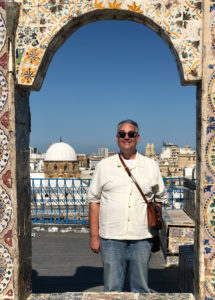
As you will read elsewhere in this newsletter, I led a project to Tunisia in September. I was joined by two faculty colleagues — Carolyn Nielsen and Joe Gosen — as well as six of our most excellent students. In Tunis, we worked closely with a group of faculty and students from IPSI (L’Institut de Presse et des Sciences de l’Information), which is the public university responsible for training Tunisian journalists. The run-up to Tunisia’s second democratic presidential elections since the 2011 Jasmine Revolution was a thrilling time to work with students on reporting projects. We will be welcoming our Tunisian partners to Bellingham for a week this year. One of my biggest hopes is that we will be able to provide more international experiences like this for our students in the future.
This has been a busy year for me in terms of research. I worked as part of a team with researchers from Washington State University, Columbia University and the Pennsylvania State University on a wide-ranging, multi-platform report on Islamophobia in the 2018 midterm election. The report, which was released in November, was the subject of media coverage in outlets like the Washington Post, the Detroit Free Press and the Newark Star-Ledger. I co-authored op-eds based on our work for the New York Times, Foreign Policy and The New Arab. We are continuing to analyze our data and will be continuing this work throughout the election year.
I had success in research collaborations with WWU colleagues this year. Joe Gosen and I analyzed media coverage of the burkini swimsuit with Shahira Fahmy of the American University in Cairo for an article that was published in Journalism & Mass Communication Quarterly. Derek Moscato and I worked on research on the public relations of the Council on American-Islamic Relations with Mariam Alkazemi of Virginia Commonwealth University. This paper won the Doub Newsom Award at the Association for Education in Journalism & Mass Communication (AEJMC) conference in Toronto. Finally, my ongoing work with Sheila Webb on improving our senior seminar class took second place in AEJMC’s Mass Communication and Society division’s teaching ideas competition.
Going back to my punk rock roots, I published a new and substantially revised editions of my biographies of the Ramones and the Clash, which are geared for the seventh grade level. I was honored to be interviewed a part of KEXP’s International Clash Day celebrations.
If 2020 ends up being half as eventful as 2019 was, it’ll still be a busy year!
If nothing else, 2019 is shaping up to be a year of expanding international horizons for me.
As I write this, I’m living in Amman, Jordan as a Fulbright scholar. I’m teaching master’s students in the University of Jordan’s Prince Al Hussein bin Abdullah II School of International Studies. I’m also studying the Jordanian Arabic dialect, and learning how to play the oud. Amman is a fascinating and vibrant city, although the winter is turning out to be just as cold and rainy as it is in Bellingham.
In July, I’ll be heading to the World Journalism Education Congress in Paris to present three papers, all related to my current research about journalism education and curriculum design.
In August, I’ll be traveling to Tunisia with professors Joe Gosen and Carolyn Nielsen and six of our top-notch journalism students for a series of reporting workshops with faculty and students from L’Institut de Presse et des Sciences de l’Information and journalists from the Tunis-Afrique Presse wire service. We are able to embark on this project thanks to a $100,000 grant from the U.S. Embassy in Tunis. In spring, 2020, a group of Tunisians will visit Bellingham as part of the same project.
While I’ve got a lot of international work happening, I’m also conducting research back home. Washington State University’s Lawrence Pintak and I are working on a multifaceted research project about the experiences of the unprecedented number of Muslim-American candidates who ran for office in the 2018 midterm elections. This project includes a survey, an analysis of media coverage and social media traffic and interviews with candidates. Our work was honored with a Senior Scholar grant from the Association for Education in Journalism and Mass Communication. I’m also working with professor Derek Moscato on research on press releases from the Council on American-Islamic Relations.
I have managed to keep up with my first love, music journalism. I recently published an article about the Jordanian/Palestinian band 47Soul in Detroit’s Metro Times alt-weekly. New editions of my young adult biographies of punk bands The Ramones and The Clash were released in January by Enslow Publishers. I wrote the original books before I went back to grad school to get my Ph.D. I’m a much better researcher now, and I was better able to access archival materials for these books, and I think the new versions are much improved.
Of course, 2017 has been a momentous year for anybody who cares about journalism. World events have given us a lot to talk about in the classroom, and our students seem especially fired up about the importance of journalism’s civic mission. This year, I had the opportunity to teach an honors seminar on religion and news, and I took my first crack at teaching feature writing.
I’ve continued to teach senior seminar each quarter, and I have been working with colleagues in Western Libraries on a yearlong research project to help students design research projects that are more meaningful to them.
The year began for me with a couple of invitations from the League of Women Voters of Bellingham/Whatcom County to give presentations on the concept of “fake news.” In February, I gave a talk about my research into media representations of Muslims and Islam as part of Western Libraries’ reading series.
On the research front, a highlight of the year was the publication of my article, “Permitted to Build? Moral Foundations in Newspaper Framing of Mosque-Construction Controversies” in Journalism & Mass Communication Quarterly. Another article I co-authored was a finalist for that journal’s outstanding article of 2016 award.
I have a lot of research projects in process, with a half-dozen articles undergoing peer review currently. Working with colleagues, I contributed to a book chapter about TV network news coverage of immigration and deportation narratives for the forthcoming book, “The Trump Presidency, Journalism, and Democracy.” I presented papers at the International Communication Association conference in San Diego and the Association for Education in Journalism and Mass Communication in Chicago. The AEJMC conference was preceded by a tour of Chicago area sacred spaces that I organized in my role as teaching chair of the Religion and Media Interest Group.
I was awarded a research fellowship from the Rock and Roll Hall of Fame Library & Archives and the Center for Popular Music Studies at Case Western Reserve University to conduct research on the legendary Detroit proto-punk band the MC5. I spent a week in the archives in Cleveland, and I’ll be devoting a lot of my research energies to this project in 2018. This is research that is dear to my heart, and it will be nice to get back to my music journalism roots.